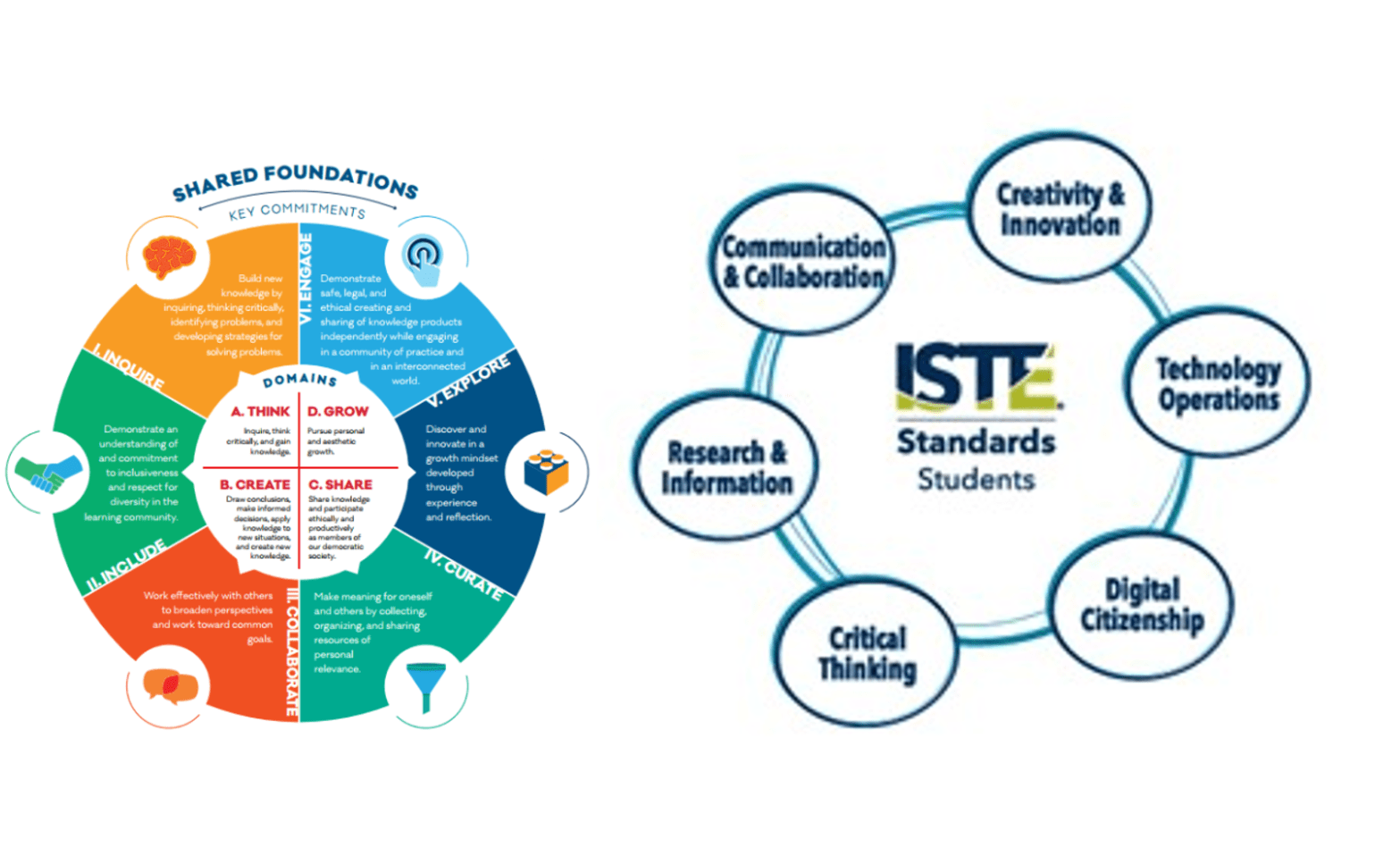
Being in my fourth year of teaching, I have come to understand and adapt myself around the importance of using standards to promote student learning. Upon examining the AASL and ISTE standards, it became even clearer to me the overwhelming impact these standards can have on student learning. When I say “student learning” I am not just speaking academically, but also by obtaining life skills necessary to have in order to be a contributing, engaging, and collaborative thinker within society.
Technology is constantly and consistently evolving and is a part of most everyone’s daily life in some way or another. Preparing students to obtain and utilize technological and digital skills is critical to have as a 21st century citizen. Gerakois (2016) explains how the Future Ready Schools (FRS) initiative suggests “school librarians as likelly leaders in the digital transformation of learning” and FRS are “developing resources and strategies to help librarians fulfill this vital role,” (para. 2). As a school librarian, it is important that these skills be identified and taught to students.
The AASL and ISTE standards are both very important and powerful tools for school librarians to utilize in school libraries. When viewing the Crosswalk between the AASL and ISTE standards, it becomes quite clear the similarities and differences between the two standards. Both standards have a high emphasis on student inquiry, where critical thinking promotes identifying and solving problems. The two standards share a great importance on collaboration as well, envisioning that students can work with others to expand their perspectives and work together towards goals. Both standards put an emphasize on exploration, too, aspiring to have students’ experiences broaden as they learn. Being engaged is another similarity between the two standards, where students share and communicate with others what they are doing and have learned.
A difference between the two standards is that ISTE does not place too much emphasis on inclusion during the learning process. Learning networks that enable the learning process is prominent and Lewis explains that ISTE’s version of inclusion is more aligned with STEM/STEAM endeavors (2019). AASL, however, puts a great deal of emphasis on inclusion during the learning process as promotes unbiased perspectives, awareness of other perspectives, and building empathy for diversity. It seems ISTE’s standards primarily focus on inclusion of technologies whereas AASL’s standards lean more toward inclusion of others.
Another difference is the lack of standards ISTE has with curating. Tools, platforms, prototypes and other methods are used to “create collections of artifacts” through digital resources (American Association of School Libraries, p. 4), promoting the standard through technology, yet again. AASL is geared more towards understanding which information is needed to be preserved, using appropriate resources to collect and contribute to the information, and deeming the appropriateness of the curated information.
In conclusion, both standards seem like a great tool for school librarians to use, although not separately. When combined, the AASL and ISTE standards could prove to be a powerful tool since they are both, in their own ways, “learner-determined” (O’Connor, 2019). Just like most things, especially in the educational world, pulling from multiple sources is usually better than sticking to just one tool or resource. Therefore, using both standards to compliment and prepare the school library and all its users, any school librarian can accomplish teaching social and technological skills that all students need to be equipped for the 21st century.
References
American Association of School Librarians. (2018). National school library standards crosswalk with ISTE standards for students and educators. https://standards.aasl.org/wp-content/uploads/2018/08/180828-aasl-standards-crosswalk-iste.pdf
Gerakois, J. (2016, July 25). Are you a future ready librarian? Knowledge Quest. https://knowledgequest.aasl.org/future-ready-librarian/
Lewis, C. (2019). Leveraging crosswalks for communication. Knowledge Quest 47(5), 42-43.
 All Things: School Libraries